BeeWarm homeowner guide · Lower Mainland
Rheem PROE60 T2 CN87: capacity, voltage and recovery
Read the current Canadian CN87 row: separate US and Imperial gallons, electrical input and recovery before comparing a replacement.
4 min read · Heating & Hot Water editorial team · Published 2026-11-02
Robert Hamilton · BeeWarm · Manufacturer sources checked 2026-11-02
In this guide
Read the current row before calling it a 60-gallon tank
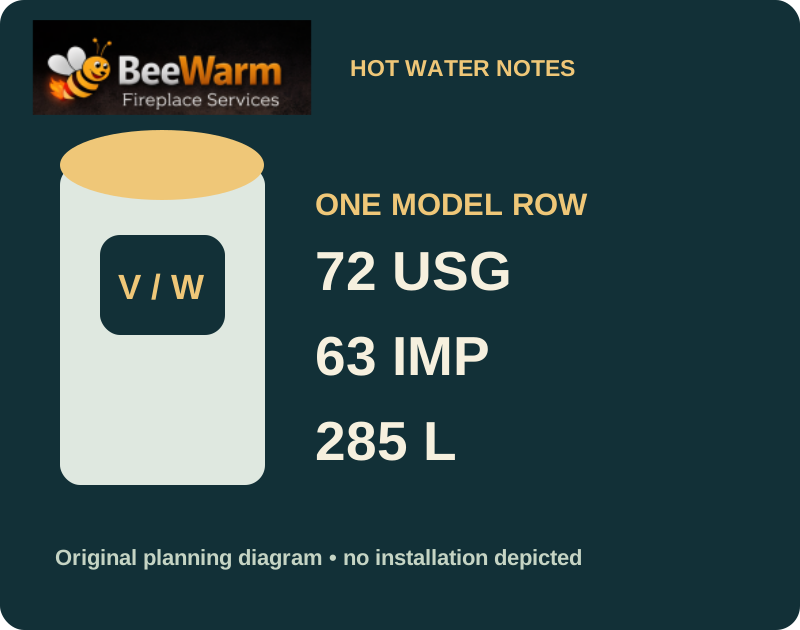
For Rheem PROE60 T2 CN87, the Canadian specification linked by Rheem on November 2, 2026 lists 72 US gallons, 63 Imperial gallons and 285 litres in the storage columns. The document is form 06.25-RH-PRO-E-SS-CAN. Keep all three labels with the model when comparing a quotation. The “60” inside the model name is not a substitute for the current capacity row, and a bare “60 gallon” description does not establish which unit or document the seller means.

Why an older brochure can lead to the wrong comparison
The current product webpage identifies the model and electric fuel, while its general capacity selector and series copy do not provide a clear exact-model capacity comparison. Use the linked Canadian specification table for that task and ask the supplier to confirm the equipment being offered. If an old quotation or downloaded brochure differs, keep the document revision visible and request a current written clarification. Do not silently combine a capacity from one revision with recovery, dimensions or electrical information from another. This guide does not claim that an older tank at your home has changed capacity.
Voltage belongs beside the element input
The same CN87 row lists 3,380 watts at 208 volts and 4,500 watts at 240 volts. Treat these as alternative listed supply configurations, not two power inputs to add together. Ask the electrical professional to confirm the actual supply and the exact ordered unit. The brochure’s recovery calculation uses 4,500-watt elements operating non-simultaneously. A pair of elements in a description therefore does not justify assuming twice that recovery. This is a specification-reading point, not a wiring recommendation, circuit size or permission to inspect live equipment.

Compare delivery and recovery against your busiest period
The table gives this model a first-hour figure of 87 GPH, and the sheet’s recovery example is 21 US gallons per hour at a 90°F rise under its stated 4,500-watt assumption. Keep the test conditions and unit basis with those figures. The first-hour footnote says those values are informational and are not listed with Natural Resources Canada. Neither number is a promised count of showers in your household. Ask how the proposed heater would address the actual pattern of consecutive and overlapping uses, particularly if your available electrical configuration differs from the recovery example.
Bring a short demand record to the comparison
Describe when hot water becomes inadequate, which fixtures are being used and whether the problem is new. For example, a household can note that the difficulty follows consecutive showers rather than appearing at every tap all day. That is a hypothetical way to record a symptom, not an assessment of this model. Distinguish changed household demand from a recent change in the existing system’s behaviour. Ask whether the first step is a service assessment or a replacement comparison before deciding that a larger stored volume solves the concern.

Make the quotation cover the whole replacement
Have the proposal identify the exact model, applicable document revision and electrical configuration, alongside removal, access, plumbing, electrical review and commissioning responsibilities. For a strata property, establish equipment ownership and the process for arranging any shared-service interruption. The existence of an electric tank does not by itself confirm that a different unit fits the space, access route or utilities. Ask the responsible professionals to verify the actual location and approvals. This article does not establish current stock, an installed price, rebate eligibility or suitability for a particular building.
Keep a model record after the decision
Retain the accepted quotation, manufacturer documents and handover information together. Ask the installer to identify the equipment supplied and explain which operating and maintenance instructions apply. Record later changes in demand separately from maintenance or repair findings. A document-based comparison is most useful when you can trace each figure to the exact offered unit, rather than only to a brand or a family of tanks. Keep personal addresses, serial photographs and private service records in your own files, not a public comment or project page.
Discuss the equipment and scope with Robert
For Lower Mainland installation enquiries, contact Robert Hamilton at BeeWarm with the current heater information, property type, observed problem and quotation details. Include the full Rheem model and the Canadian sheet if it is already under consideration. Ask Robert to confirm the work BeeWarm can undertake and the electrical involvement required; confirm availability directly. This manufacturer-research article is part of Robert’s BeeWarm series. It reports no installation, personal test, manufacturer endorsement or guarantee of hot-water performance.
Sources & further reading
- Rheem: exact PROE60 T2 CN87 Canadian product page
- Rheem: Canadian specification 06.25-RH-PRO-E-SS-CAN, linked by the product page
Check the selected manufacturer’s current instructions. Program eligibility and installation requirements can change.
Continue comparing
Make this useful for your project
Build a short installation brief with the details and questions to bring to an assessment.
Build my installation brief →